Two suspects are interrogated separately. Each has two choices: stay silent or confess. The sentence structure is as follows (in years): if both stay silent, each gets 1 year; if both confess, each gets 5 years; if one confesses and the other stays silent, the confessor goes free and the silent one gets 10 years. This setup is called the prisoner’s dilemma. Merrill Flood and Melvin Dresher at RAND constructed it in 1950; the name and the prison-sentence story are due to Albert Tucker[1].
This structure is not limited to police stations. Price wars, arms races, network congestion, and R&D competition all share the same shape: the option that is best for me individually makes the overall outcome worse when everyone picks it. This is a common problem in economics, biology, and network engineering, and game theory is the mathematical tool for analyzing it.
The answer is the Nash equilibrium. In 1950, John Nash proved that in any finite game there exists a strategy combination in which no player can improve their own outcome by changing their strategy alone[4]. In the prisoner’s dilemma, “both confess” is exactly that equilibrium. The key point: a Nash equilibrium is a stable outcome, not a best outcome. “Both stay silent” is better for both, but it cannot be sustained, because each player has an incentive to deviate on their own.
1. The problem: the payoff structure of the prisoner’s dilemma
| B stays silent | B confesses | |
|---|---|---|
| A stays silent | A: 1 year, B: 1 year | A: 10 years, B: 0 years |
| A confesses | A: 0 years, B: 10 years | A: 5 years, B: 5 years |
The specific sentences are the standard illustrative setup; what matters is the ordering of the payoffs, not the specific values[1]. From A’s perspective, fewer years is better, and the four outcomes order as:
0 years (I confess, the other stays silent) < 1 year (both silent) < 5 years (both confess) < 10 years (I stay silent, the other confesses)
This ordering has two consequences. First, no matter what B does, A’s outcome from confessing is better than from staying silent (0 < 1, 5 < 10). “Confess” is A’s dominant strategy. B is in the same situation. Second, “both confess” (5 years each) is worse for both than “both stay silent” (1 year each).
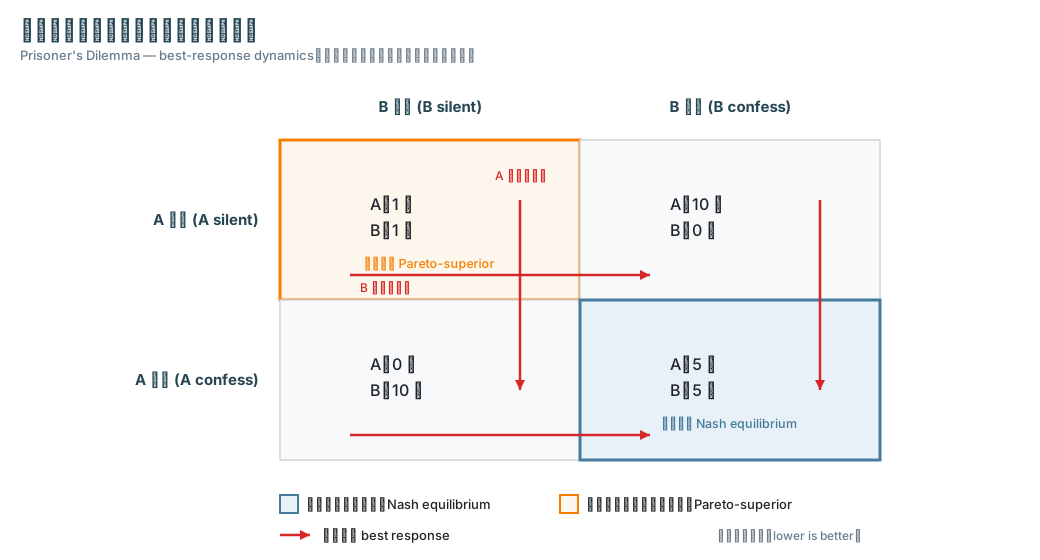
Figure: The 2×2 payoff table of the prisoner’s dilemma with best-response arrows. The red arrows are each player’s best response to the other player’s choice; all four arrows point to “both confess” — the unique Nash equilibrium (blue frame). “Both silent” (orange frame) is better for both, but it is not an equilibrium. The sentences are standard illustrative numbers; schematic, not measured.
So the problem is: each player picks the option that is best for themselves, and the result is a mutual loss.
2. The principle: best response and Nash equilibrium
Given the other player’s strategy, the strategy that maximizes my own payoff is called my best response to that strategy. In the prisoner’s dilemma, if the other stays silent, my best response is to confess (0 years < 1 year); if the other confesses, my best response is also to confess (5 years < 10 years).
In 1950, Nash published a two-page note in the Proceedings of the National Academy of Sciences, proving that in any finite game (finitely many players and finitely many strategies), there exists a strategy combination in which each player’s strategy is a best response to the other players’ strategies[4]. This strategy combination is called a Nash equilibrium. The complete proof was published in the Annals of Mathematics in 1951[5].
The definition of a Nash equilibrium has two layers:
- Stability: no player can improve their own payoff by changing their strategy alone.
- Mutual best response: each player’s strategy is a best response to the others'.
In the prisoner’s dilemma, “both confess” is the unique Nash equilibrium.
The history of the field: in 1928, von Neumann proved the minimax theorem — in a two-player zero-sum game (one player’s gain is exactly the other’s loss), optimal strategies exist for both sides, and the value of the game is computable[2]. In 1944, he and Morgenstern published Theory of Games and Economic Behavior, establishing game theory as a discipline and extending it to economics[3]. But the minimax theorem covers only zero-sum games. The prisoner’s dilemma is a non-zero-sum game (the sum of both players’ payoffs changes with the outcome), and Nash’s 1950 result filled exactly this gap. In 1994, Harsanyi, Nash, and Selten jointly received the Nobel Memorial Prize in Economic Sciences “for their pioneering analysis of equilibria in the theory of non-cooperative games”[6].
3. Why the equilibrium is not optimal: the gap between Nash and Pareto
Pareto optimal: an outcome is Pareto optimal if no one can be made better off without making someone else worse off.
In the prisoner’s dilemma, “both stay silent” (1 year each) Pareto-dominates “both confess” (5 years each): both are better off, and no one is worse off. But “both stay silent” is not a Nash equilibrium — if the other stays silent, my best response is to confess (0 years < 1 year).
So the core answer is: “rationality” in game theory means “no player can improve their own payoff by changing their strategy alone,” not “maximizing the sum of both players’ payoffs.” A Nash equilibrium is stable, not optimal. Rationality (in the narrow sense) does not guarantee a collectively good outcome.
4. Limitations: when the dilemma can be escaped
The one-shot prisoner’s dilemma conclusion rests on four assumptions:
- The game is played only once, with no future interaction.
- The two players cannot reach a binding agreement.
- Each player is fully rational and cares only about their own payoff.
- Both players know the payoff structure and know that the other is rational (common knowledge).
If any of the assumptions breaks, the conclusion changes:
- Repeated interaction: in 1980 and 1981, Axelrod ran two computer tournaments in which each strategy played 200 rounds of the prisoner’s dilemma against every other strategy, scored by total payoff. The simplest strategy, TIT FOR TAT (cooperate on the first move, then copy the other’s previous move), won both tournaments[8]. His 1984 book The Evolution of Cooperation showed that cooperation can emerge among self-interested players in a world without central authority, if the game is repeated enough times[8].
- Evolutionary perspective: in 1973, Maynard Smith and Price proposed the evolutionarily stable strategy (ESS) — a strategy that, once fixed in a population, cannot be invaded by a mutant strategy. It applies the logic of game theory to animal behavior and explains how cooperation and conflict evolve[7].
- Institutions and enforcement: contracts, laws, and reputational mechanisms change the payoff structure (defection has a cost), which is equivalent to changing the game itself.
5. The answer: the limits of rationality
“Rationality” here means “no player can improve their own payoff by changing their strategy alone,” and “both confess” is exactly the stable point where everyone is playing their best response. Stability is not optimality: “both stay silent” is better for both, but it cannot be sustained, because each player has an incentive to deviate on their own.
Common misconceptions
- “Nash equilibrium = the best outcome for everyone”: wrong. An equilibrium is only a state where no one has an incentive to deviate alone; it can be worse for everyone than some other outcome (the prisoner’s dilemma is exactly that example).
- “Game theory is a collection of poker tricks”: wrong. Game theory is the mathematical study of decision-making under strategic interaction; “games” are models, not gambling advice.
- “All games are zero-sum”: wrong. In a zero-sum game, one player’s gain is exactly the other’s loss; in the prisoner’s dilemma, the sum of both players’ payoffs changes with the outcome (non-zero-sum).
Self-check for readers
- In the payoff table of Section 1, why is “confess” a dominant strategy?
- How does a Nash equilibrium differ from a Pareto-optimal outcome? Give an example.
- In a repeated prisoner’s dilemma, why can TIT FOR TAT promote cooperation?
Back to the opening question: why do two rational people make a decision that hurts both? Because “rationality” means “no player can improve their own payoff by changing their strategy alone,” and “both confess” is exactly the stable point where everyone is playing their best response. Stability is not optimality: “both stay silent” is better for both, but it cannot be sustained, because each player has an incentive to deviate on their own.
Applicable conditions and limits: the one-shot prisoner’s dilemma conclusion holds only under the four assumptions in Section 4; with repeated interaction, binding agreements, or institutional constraints, the outcome can differ from the one-shot Nash equilibrium. How to design specific institutions so that the new game’s equilibrium is a good outcome is a separate design problem, not covered by the sources cited here.